Sandy Ordille She Chose to Stay - Part 1
How one quiet decision carried Carlsbad local Sandy Ordille across a lifetime of waves, friendships, and purpose.

Learning the Tide
At sixteen years old, Sandy Ordille stood quietly beside a van in a parking lot while everyone else prepared for the long drive back to New Jersey.
The East Coast Championships had come to an end. Surfboards were strapped to roof racks. Friends exchanged hugs and promised to see one another at the next contest.
For the first time, her older brother wasn't there.

He had already moved away to attend college in Florida, making this the first championship they hadn't shared together.
Now Sandy had a decision to make.
She could climb inside the van and go home.
Or she could leave with family friends who lived near her brother, giving her the chance to spend more time with the person who had first inspired her to surf and trusting that somehow everything else would fall into place.
It wasn't a dramatic decision. There were no speeches. No grand announcement. Just a teenager standing quietly beside a van.
Instead of returning to New Jersey, Sandy traveled to Florida with family friends, who agreed to become her legal guardians. Eventually she had to call her mother and explain that she wasn't coming home.
Looking back, it was one of the most important decisions she ever made.
At the time, it simply felt like the right one.
To understand why that moment mattered, though, you have to go back to where it all began.
Long before sponsorships, prize purses, or livestreams from the world's biggest events, surfing looked very different. There were no roadmaps. No guarantees. If you wanted to build a life around surfing, you simply paddled out and figured it out.
For Sandy, that journey began with a little Styrofoam surfboard on the East Coast.

Surfers of the 1960s captured the essence of a carefree and adventurous lifestyle.
Growing up in the 1960s, surfing wasn't viewed as the wholesome lifestyle it has become today. Her father, an avid tennis player, associated surfing with the rebellious culture of the era and wasn't eager for his children to get involved. But Sandy's older brother had already fallen in love with the sport, and she watched him with admiration.
"He was my inspiration," Sandy recalls.
His board was a massive 9-foot-6 Hobie—far too large for a little girl to carry—but that didn't stop her fascination. Seeing her interest, Sandy's mother found a molded Styrofoam board that was small enough for her to manage. It wasn't fiberglass, and because of its size she was allowed to surf inside the designated swimming area after regular surfers were required to leave the water each morning. (Yes, at one point surfers were kicked out of the water so others could play.)

Then came the moment every surfer remembers.
Her brother pushed her into her first wave.
She couldn't steer the board, and she barely knew what she was doing. But the feeling of standing on a wave—even for those few brief seconds—was enough to keep her coming back.
Before Sandy was allowed to venture into the ocean on her own, her mother enrolled her in a community water safety program, where she learned swimming, breath control, and ocean awareness. Looking back, Sandy credits her mother with quietly laying the foundation for a lifetime spent in the sea.
When Sandy was twelve, her parents divorced, and her mother made a courageous decision that changed the course of the family's life. They moved to Ocean City, New Jersey, a quiet barrier island where the beach was never far away. With its long-standing Blue Laws prohibiting alcohol sales, bars, and gambling, Ocean City was known as a family community—a place where kids spent their summers riding bikes, fishing, and, for a growing group of surfers, chasing waves.
For Sandy, it was the perfect place to grow up.
Surfboards balanced alongside bicycle handlebars became a familiar sight as she and her friends pedaled through town searching for the best sandbars. If the waves looked good, the bikes were abandoned in the sand, and the rest of the day belonged to the ocean.
There were no surf forecasts, no webcams, and no smartphone apps. You checked the surf by going to the beach.
Winter brought a different challenge. East Coast surfers didn't wait for warm water. They pulled on heavy wetsuits—often hand-me-downs that didn't quite fit—and paddled into the cold Atlantic. Some mornings slushy ice floated near the jetties. Snowstorms that closed schools often meant one thing: more time to surf.
Those winters built a toughness shared by many East Coast surfers of Sandy's generation. Learning to surf in changing tides, cold water, and unpredictable conditions created an appreciation for every good wave, no matter how small.
As surfing continued to grow, the Eastern Surfing Association gave young surfers a chance to compete throughout the season. Families improvised homemade surfboard racks before commercial versions existed, loaded station wagons and vans with boards, and spent weekends traveling from contest to contest. It was competitive, but it was also a close-knit community. Lifelong friendships were formed in beach parking lots long before anyone paddled into a heat.

Each season eventually led back to the East Coast Championships.
And for Sandy, one championship would end with a quiet decision in a Florida parking lot that changed the course of her life forever.
Heading West
The decision to stay in Florida marked the beginning of a new chapter.
For the next few years, Sandy immersed herself in the state's surfing community while staying close to her brother. The East Coast had given her a strong foundation, but Florida introduced her to new friendships, new experiences, and a broader surfing world. More than anything, it confirmed something she had already begun to realize.
She wanted surfing to be more than something she did.
She wanted it to shape the life she built.
A few years later, another unexpected turn came along.
Sandy and her brother answered an advertisement for a drive-away service transporting vehicles across the country. Along with two other drivers, they were assigned a Cadillac that needed to be delivered from Jacksonville to San Diego.

Taking turns behind the wheel, they drove nearly nonstop across the country. For Sandy, it was her first glimpse of Southern California and the place she had heard surfers talk about for years.
When they delivered the car, they learned it belonged to the owner of the San Diego Chargers.
Before they left, he handed them a $500 tip.
For many people, it would have been an unexpected payday.
Sandy saw something different.
She saw an opportunity.

The money wasn't simply enough to pay a few bills. It became the first real chance to build a life around surfing in Southern California. It helped secure a small apartment tucked behind PB Surf Shop in Pacific Beach, placing her in the middle of the surfing community she had dreamed about from thousands of miles away.
It wasn't much.
But it was enough to get started.
There was no job waiting for her.
No guarantee California would work out.
Just a surfboard, a small apartment, and the belief that she would find her place.
Looking for work, Sandy and fellow surfer Maryanne Hayes walked into PB Surf Shop and asked owner Bill Andrews if they could repair surfboards.
Bill wasn't convinced.
Rather than hiring them on the spot, he handed them a damaged board and asked them to prove they could do the job.
They repaired it, finished it with a polished gloss coat, and brought it back.
That was all the proof he needed.
They got the job.

Her days revolved around the ocean. When the surf was good, she was in the water. When customers brought in damaged boards, she repaired them, often working late so they would be ready before the next swell arrived.

It wasn't glamorous work.
But it kept her close to the lifestyle she loved, while also attending college.
Then everything changed when Sandy learned about the newly formed International Professional Surfers (IPS) tour. For surfers willing to travel, it offered the chance to compete at some of the world's best waves.
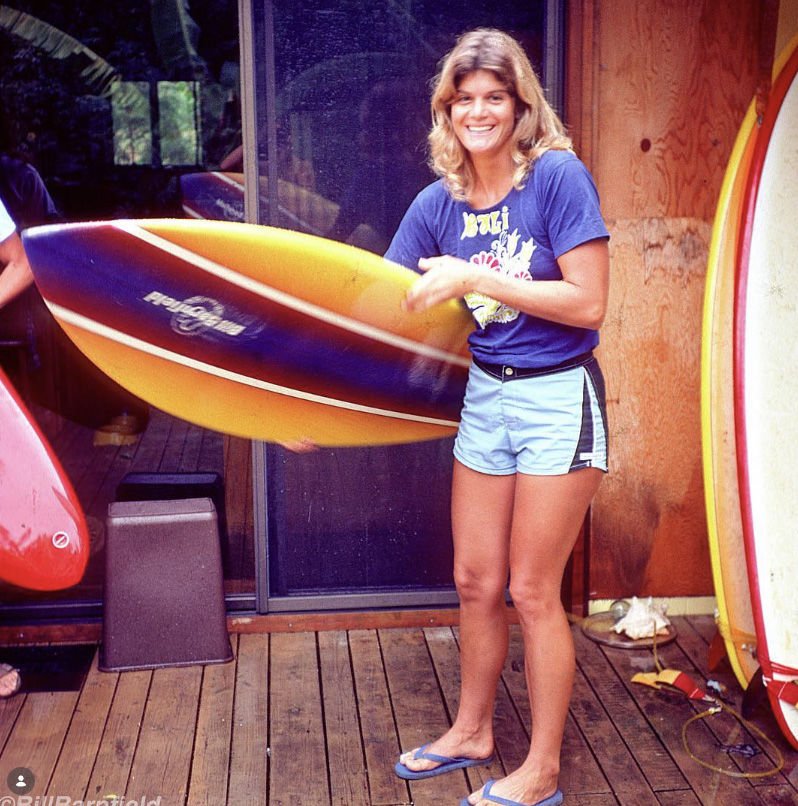
The decision came quickly.
She sold her Toyota.
Left college.
Bought a plane ticket.
And went.
There were no guarantees waiting on the other side.
Prize money was modest.
Travel was expensive.
Contest winnings alone weren't enough to support most competitors.

The tour took her to South Africa, Australia, Brazil, Hawaii, and many of the world's most celebrated surf breaks. Every destination brought new experiences, different cultures, and friendships that stretched far beyond the competition site.
Like many surfers of that era, Sandy learned to be resourceful. Contest winnings alone weren't enough to support life on the road, so she relied on the skills she had already developed. Board repair, restaurant work, surf instruction—whatever was needed to keep moving forward became part of the journey.
Looking back, those years weren't defined by trophies or rankings as much as they were by the experiences they made possible. Surfing became a passport to places she had only imagined as a young girl riding her bicycle to the beach in Ocean City.
Whether it was staying in Florida at sixteen, driving across the country with little more than hope, walking into PB Surf Shop looking for work, or buying a plane ticket to compete around the world, Sandy never waited for certainty before moving forward.
She trusted that with hard work, determination, and a willingness to adapt, the path would eventually reveal itself.
More often than not...
It did.


Comments